
Viking Village shows how a second community vote can change a LEGO idea’s future
BrickHammer’s village reached production through a second chance, while its final details mix everyday activity with LEGO fantasy.
The first 10,000 supporters were not the end
Fan builder Florian, known as BrickHammer, submitted his first Viking Village to LEGO Ideas in July 2020. It reached 10,000 supporters that December but was not selected in its initial review. LEGO’s account of the project describes a second opportunity in 2022: a public vote between three previously unselected designs. Viking Village won with 16,317 votes, or 47 percent of the total.
That history is worth remembering when looking at set 21343. It is a record of a particular second-chance initiative, not a rule that an unsuccessful submission will automatically receive another vote.
From a fan concept to a village with jobs
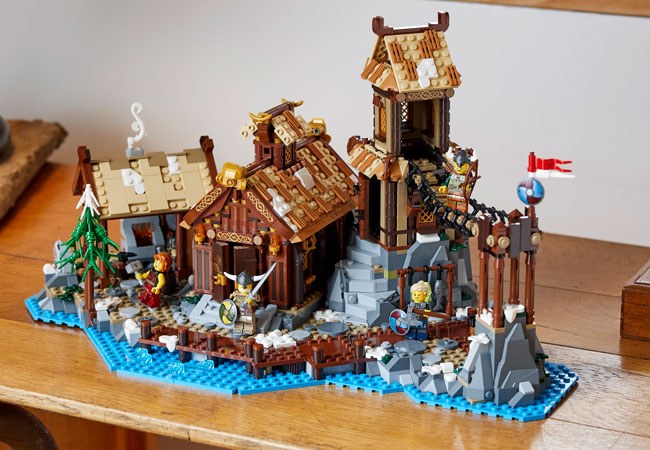
LEGO’s design-team interview credits Isaac Snyder as the model designer and Johanna Wurm Jensen with graphic design. The village includes a blacksmith’s workplace, a chieftain’s longhouse and a tower linked to a lookout by a rope bridge. Its four minifigures have distinct roles, including the smith and chieftain.
Our interpretation is that those occupations give the scene its staying power. A village suggests things happening between adventures: making equipment, watching an approach or gathering indoors. A visitor can follow an activity through the buildings instead of needing a battle to explain why the characters are there.
History and fantasy share the same coastline
The official feature is clear that the design combines researched details with fantasy. Horned helmets are part of its playful visual language, not a historically accurate claim about Viking headwear. Another LEGO feature explains that the finished set drew from two BrickHammer submissions, including a cave introduced in the later version.
That makes this an interesting subject for a model discussion: which choices establish a familiar atmosphere, and which try to represent everyday life? Treating the answers separately leaves room to enjoy the model while being precise about what it can and cannot teach about the past.
A small challenge for your own village
Our suggestion for a community build is to give each contributor a role before assigning a building. One person could invent somewhere to prepare food, another somewhere to repair equipment, and another a place to welcome arrivals. Agree on how the characters move between those spaces before adding decoration.
The exercise shifts attention from how many buildings fit on a base to why they belong together. It also gives newcomers a manageable contribution with a clear purpose. BrickHammer’s story offers encouragement to keep developing an idea; the village itself offers an equally useful reminder that a convincing place grows from the lives imagined inside it.
Reporting checked October 2, 2026. Plans and programs can change; follow the linked organizations for current information.