
What LEGO’s Belgian distribution center does between factory and shop
The Tessenderlo hub offers a useful look at pallets, rail freight and the less visible work that brings finished sets closer to customers.
An important stop after the set is packed
LEGO announced the opening of its Tessenderlo regional distribution center in Belgium in June 2024. It joined the company’s existing European center in Jirny, Czechia. Looking back at that opening helps explain a part of the LEGO industry that rarely appears on a collector’s shelf: the movement and storage of finished products.
A distribution center has a different role from a factory. Our useful mental picture is a point where products arriving in large quantities can be organized for their next destinations. The bricks have already become boxed sets; the challenge now concerns where those boxes need to go and how to move them efficiently.
Pallet capacity is not an order count
At opening, LEGO described capacity for 44,000 pallets and an expected 32,000 orders annually. The hub served several markets in northwestern Europe, including Belgium, the Netherlands, Luxembourg, Great Britain, Ireland and northern France, as well as LEGO retail. A co-located LEGO.com fulfillment operation was supplied from the regional center.
Those figures measure different things. Pallet capacity describes storage, while annual orders describe an expected flow of work. Neither tells a reader how many individual fans bought a set. Separating those measures matters when interpreting warehouse news: a large business order and a parcel addressed to one household should not be casually counted as equivalent events.
The operator explains the transport pattern
Logistics partner Kuehne+Nagel’s June 7, 2024 announcement described a €70 million investment and planned rail arrivals from LEGO factories in Hungary and Czechia. It also projected around 5,500 truck departures annually. These were opening-era descriptions and expectations, not newly audited October 2026 performance figures.
The combination illustrates why a rail-based supply route still needs road transport. In our interpretation, the hub connects different scales of movement: concentrated inbound loads and onward deliveries to a broader set of destinations. The practical question is not whether one transport mode does every job, but which part of the journey each mode is intended to handle.
Read the warehouse photograph as part of the story
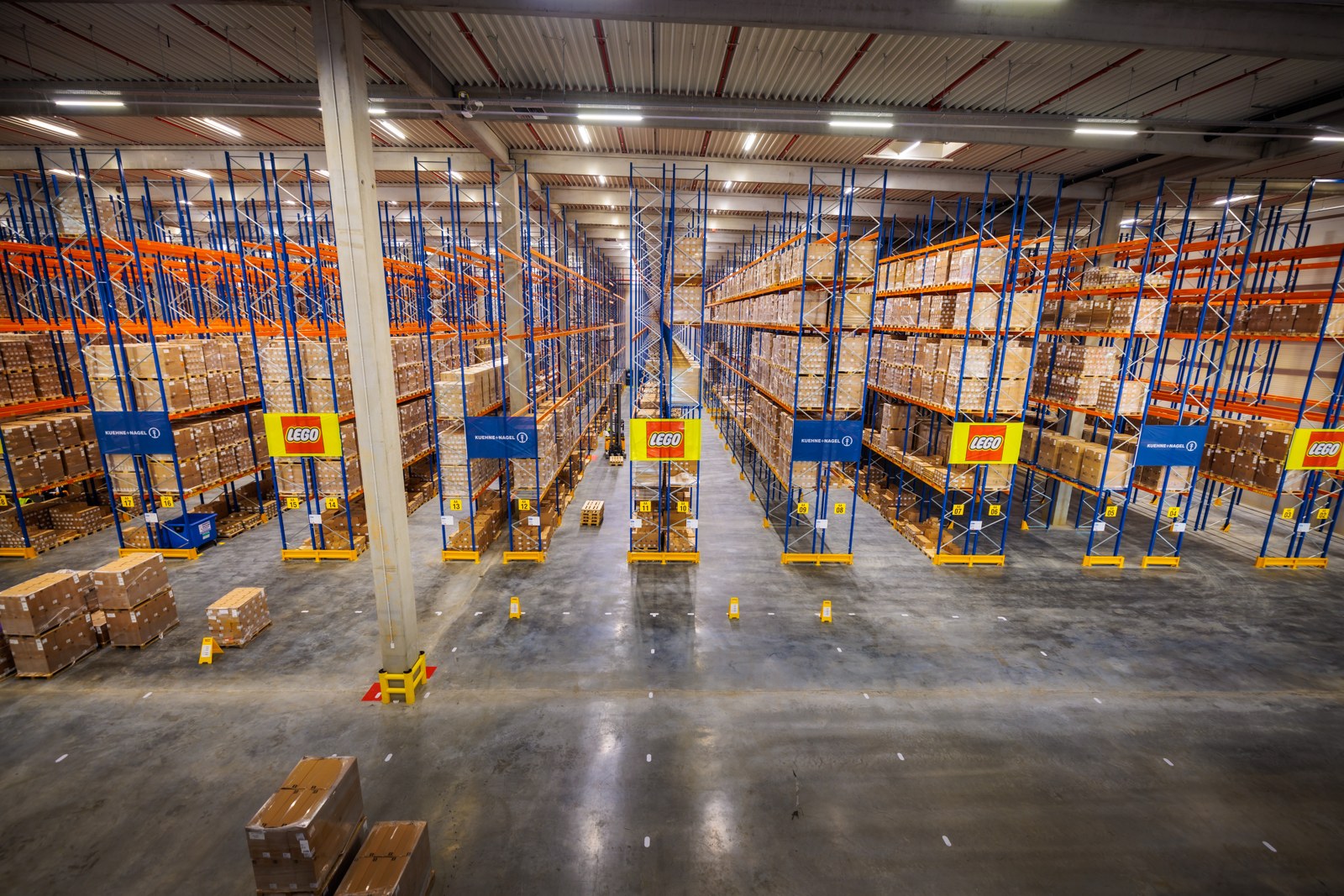
The official interior photograph shows tall racks and wide circulation aisles. It is a useful counterpoint to familiar images of molding machines or colorful store displays. Much of the space is organized around storing and moving products rather than showing them to shoppers.
For readers following the industry, the next meaningful evidence would be an operational update describing actual throughput or service results. An opening announcement establishes the planned role of a facility; it cannot establish every later outcome. Even with that distinction, Tessenderlo makes the wider LEGO journey easier to understand. Between the factory floor and a new box arriving at a shop lies an organized network of storage, transport and fulfillment.
Reporting checked October 6, 2026. Plans and programs can change; follow the linked organizations for current information.