
Peter Reid’s Exo Suit shows what a fan and a LEGO designer can solve together
A look back at the collaboration behind Exo Suit 21109, from a shared love of space builds to the practical challenge of preserving a detailed design.
A friendship behind the machinery
A finished LEGO Ideas set can hide the conversations that made it possible. Exo Suit 21109 offers an unusually clear glimpse of that process. LEGO’s July 2014 development account describes fan designer Peter Reid and LEGO designer Mark Stafford working through the challenge of turning an intricate fan model into a production set.
They already knew each other through the building community, having met while exhibiting at LEGO World in 2005. That shared history makes this a story about collaboration as much as a memorable space model. This retrospective draws on LEGO’s published account and product material; it is not a new interview or a hands-on review.
Preserving character while changing connections
The development account explains that some parts in Reid’s submission were no longer available and some connections did not meet LEGO’s standards. Stafford worked through alternatives, with Reid providing feedback and later joining him in Billund. A newly available round tile with a central hole helped resolve an arm-design problem.
For fans, our reading is that the interesting question is what survives a redesign. A model’s identity can sit in its posture, density and proportions rather than in every original connection. Changing the hidden construction may protect the visible idea. That is a more useful way to assess a development model than simply counting the differences from its submission.
The small crew makes the big machine approachable
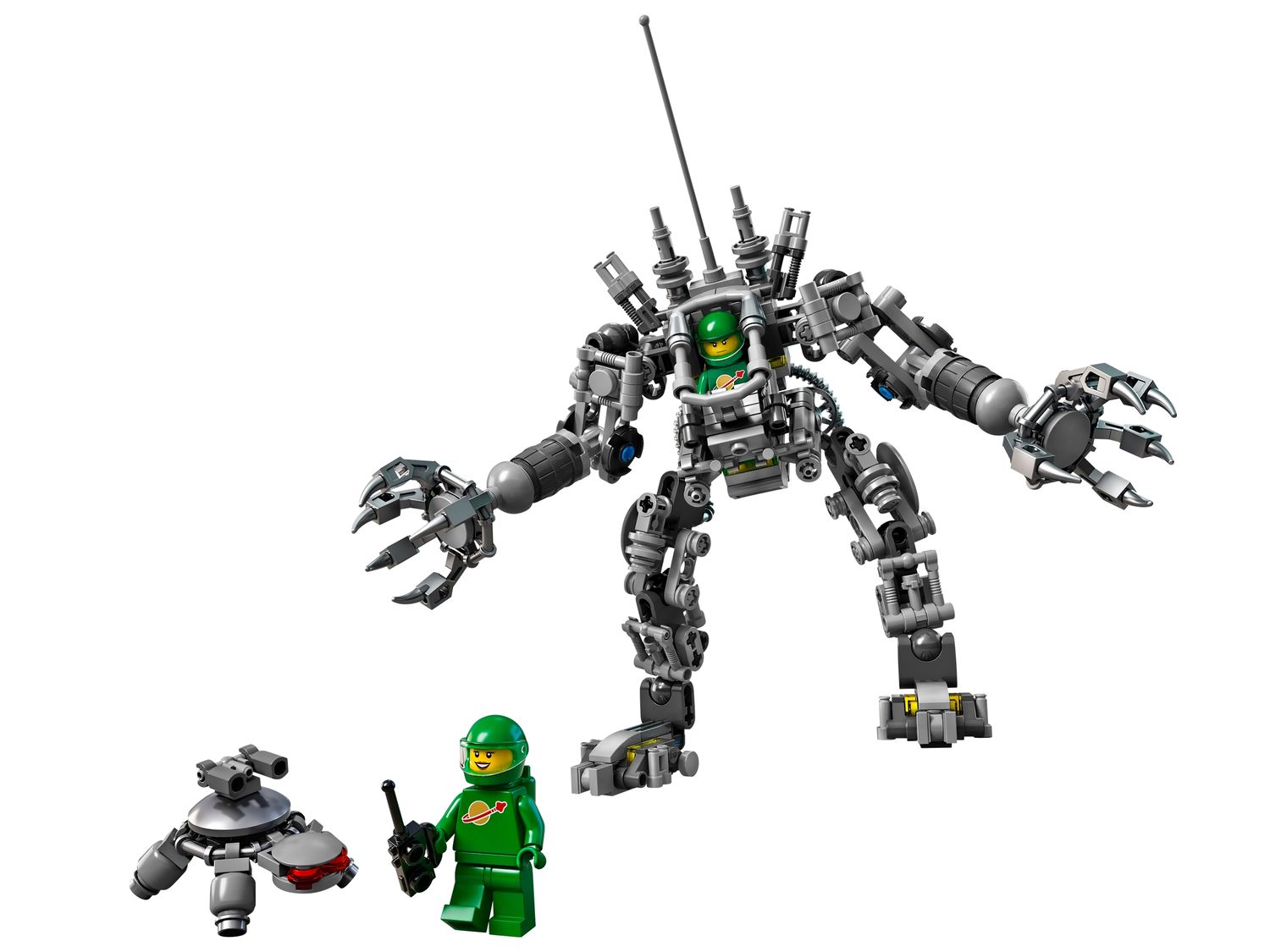
The finished 321-piece set includes Pete and Yve astronaut minifigures, a robot turtle and a suit with adjustable limbs, an opening cockpit and gripping claws. Its green Classic Space uniforms give the crew a clear visual identity against the gray machinery. LEGO now lists the set as retired.
In the official image, the exposed pilot supplies an immediate sense of scale. The robot turtle creates a second comparison: a small companion beside a much larger machine. Our interpretation is that these contrasting sizes make the display easier to enter as a story. Someone who knows nothing about the design process can still imagine a crew setting off together.
What to take to your next building session
For a collaborative fan project, try separating the discussion into two questions: what should the model communicate, and which connections are preventing it from working? That keeps a change to the structure from becoming an argument about the whole idea.
Our suggested exercise is to photograph a prototype before taking it apart, then circle the few visible features that make it distinctive. Ask another builder to help improve one weak area while preserving those features. Exo Suit’s development history is an encouraging reminder that asking for another pair of hands can be part of realizing a personal vision.
Reporting checked October 20, 2026. Plans and programs can change; follow the linked organizations for current information.