
Jonathan Brunn’s Dinosaur Fossils connected a childhood fascination with a designer’s eye
The fan creator behind set 21320 worked through the shapes of prehistoric animals before a LEGO specialist prepared them for the building table.
An interest that stayed with him
Jonathan Brunn’s LEGO Ideas Dinosaur Fossils began with an enthusiasm that never really went away. The set’s official booklet describes him as a graphic and web designer in Perpignan, France, with interests in science, space and fossil hunting. He had inherited his older brother’s LEGO collection as a young child.
For his own project, he returned to dinosaurs. The booklet records roughly two years of refinement, carried out digitally. His challenge was to represent the animals’ anatomy while keeping a consistent visual approach across very different bodies.
A second enthusiast joined the project
LEGO designer Niels Milan Pedersen brought another kind of experience. In the same booklet, he describes decades of making prehistoric-animal sculptures. Preparing Brunn’s idea for production meant revisiting its construction, color choices and reliance on specialist elements, alongside the requirements for stability and a manageable building process.
Their accounts show two distinct stages: finding an expressive concept and developing a version that other people could reliably assemble. Brunn’s successful submission created the opportunity for both interests to meet.
Three exhibits, with an important distinction
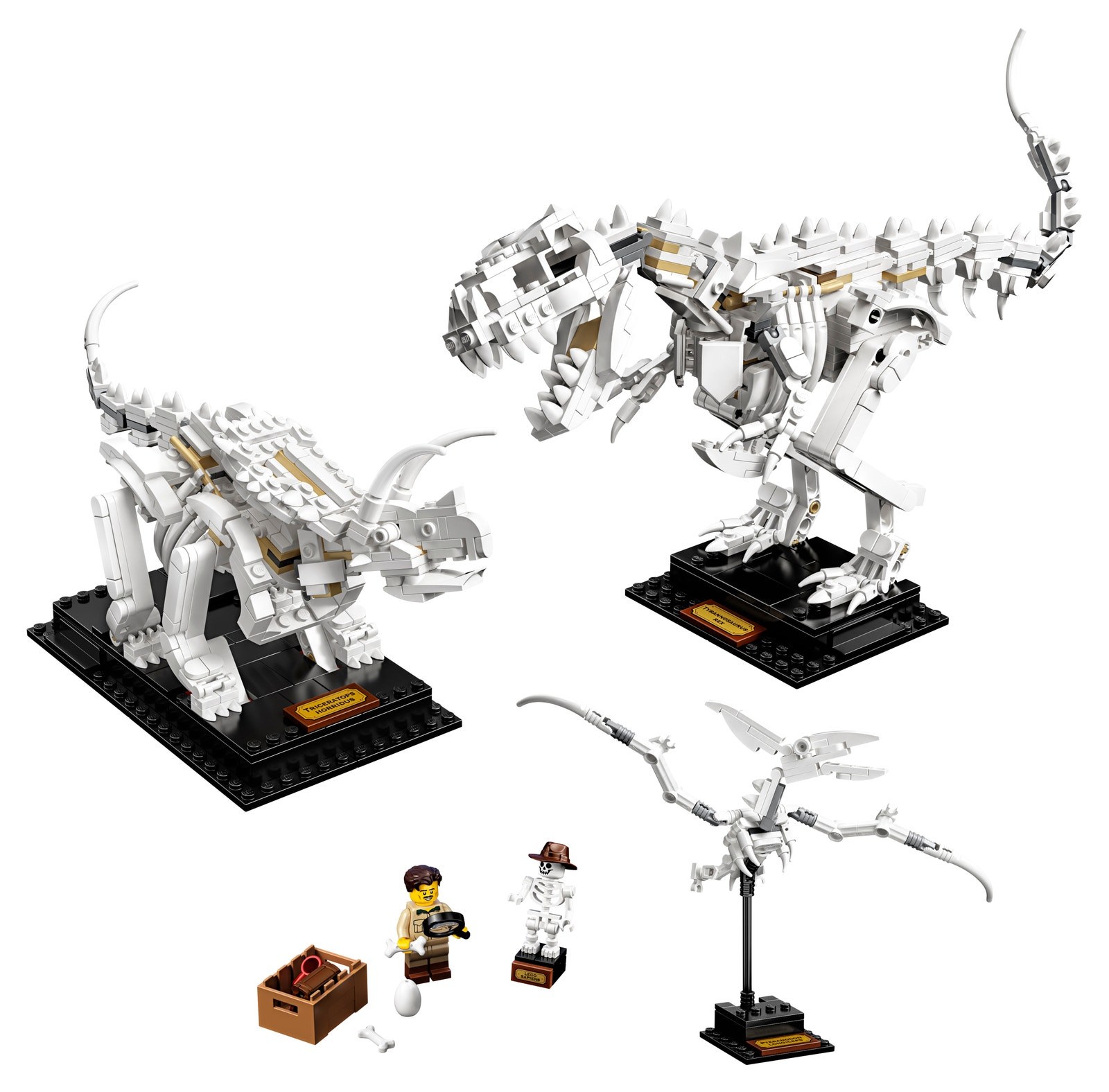
Released in 2019, the 910-piece set presents Tyrannosaurus rex, Triceratops and Pteranodon skeleton models on individual stands. LEGO describes their scale as 1:32 and includes adjustable poses, a paleontologist minifigure and a human skeleton figure. Pteranodon is a pterosaur, rather than a dinosaur, a distinction the official materials make explicit.
The product page lists 21320 as retired as of October 25, 2026. This article examines its design history and published features; it is not a hands-on review or a claim about present resale prices.
Why the museum format matters
Our view is that the stands are central to the idea’s appeal. They make the skeletons read as exhibits rather than simply pale-colored creatures. The collection becomes a small arrangement of objects to compare: a heavy skull, a broad frill and a long wing shape can share a shelf without needing an invented landscape to unite them.
That is also what makes this a distinctive fan-community story. A personal fascination became a display format that another enthusiast could recognize immediately. Brunn did not need to reproduce an entire museum for the project to communicate its subject. The grouping itself gives the models context, while the spaces between the bones keep the underlying structure visible. It is a compact tribute to curiosity, expressed through a collection rather than a single oversized centerpiece.
Reporting checked October 25, 2026. Plans and programs can change; follow the linked organizations for current information.