
Inside LEGO Jazz Club, the best story starts before the music
Jazz Club 10312 links a performance venue with the everyday businesses around it. A desk review of the modular building’s backstage storytelling.
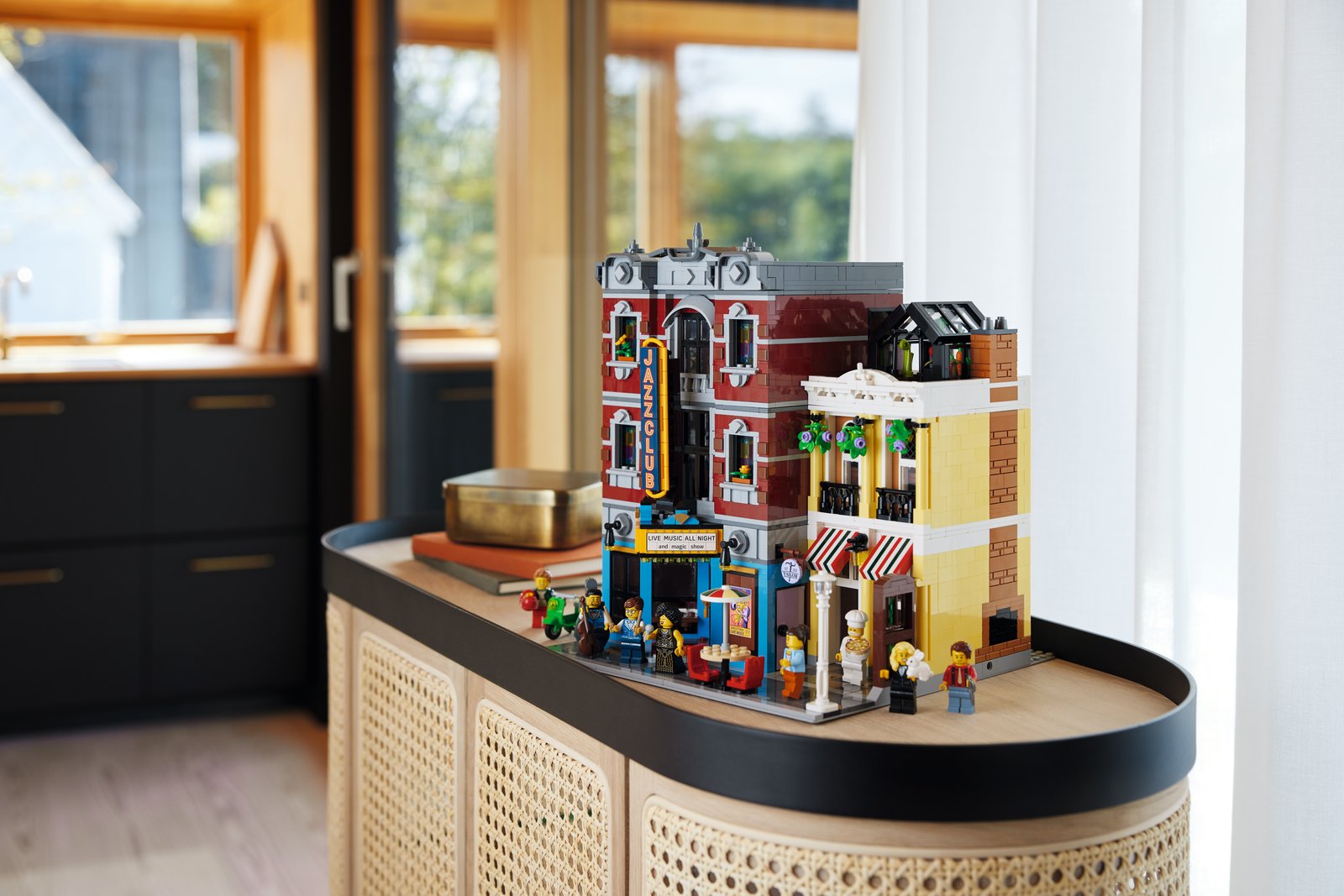
Follow the performer through the building
A stage explains what a jazz club does. The rooms around it explain how the evening happens. LEGO Jazz Club 10312 is particularly interesting when viewed as the setting for a performer’s day, with the show providing a reason for neighboring spaces to exist.
Announced in December 2022 for a January 2023 release, the 2,899-piece set includes eight minifigures and combines the club with a pizzeria, tailor’s workshop and other rooms. This is a retrospective desk review based on LEGO’s official descriptions and photography, rather than a hands-on building report.
One character connects several businesses
In LEGO’s published interview, designer Anderson Ward Grubb explains that the singer connects the spaces: collecting a dress, changing, meeting the manager, eating and finally performing. He also describes a small venue as a practical match for the limited space inside a modular building.
Our interpretation is that this gives the model a stronger organizing idea than a collection of unrelated shops. Each room can suggest an earlier or later moment in the same evening. For a home display, that offers a simple storytelling exercise: place the singer somewhere other than the stage and let the surrounding objects explain what happens next.
The street does some of the storytelling
The official product page identifies a 45-degree doorway, side connectors for neighboring modular buildings and decorated elements that require no stickers. Those details address different scales of attention: an entrance to investigate, a street to extend and small signs to read up close.
In the press photograph, the dark red club and lighter yellow neighbor have distinct identities, while the vertical Jazz Club sign gives the taller building a clear focal point. Our visual reading is that the color change makes two businesses easy to understand without requiring a much wider scene. A display can therefore feel busy while retaining a readable front elevation.
Keep some space for your own evening out
For owners arranging a modular street, our suggestion is to leave enough access to revisit the rooms rather than treating the finished facade as the only view that matters. Photograph a few character arrangements before changing them; the comparison can reveal how much a single figure’s placement changes the implied action.
For anyone considering a used example, ask for photographs of the interior furnishings and included figures as well as the exterior. The backstage details are central to this set’s appeal, so completeness deserves more attention than a flattering front view alone. The most persuasive reason to revisit Jazz Club is that the architecture supports a story with a beginning, a middle and a performance still to come.
Reporting checked October 17, 2026. Plans and programs can change; follow the linked organizations for current information.