
How a tiny LEGO bookshelf helped inspire Jason Allemann’s Maze
The creator behind Maze 21305 found an unexpected use for another fan’s building technique. A retrospective on sharing ideas and designing for movement.
A different way to look at a bookshelf
Jason Allemann’s LEGO Maze began with something much smaller than a game board. In LEGO Ideas’ April 2016 interview, the Canadian builder credited a minifigure-scale bookshelf by fellow fan Deborah Higdon with sparking the idea. Its sideways panel construction suggested maze walls to him. Small static experiments eventually became larger ball mazes and a mechanism for tilting them.
That origin makes Maze 21305 an especially appealing community story: a technique shared for one purpose became useful for another. This is a retrospective based on official sources, not a hands-on assessment of the mechanism.
Make the idea understandable in motion
Allemann told LEGO Ideas that the controls were the hardest part to resolve and required several prototypes. He also described how a demonstration video helped people understand what the project could do.
Our reading is that this is an important distinction for builders presenting a moving model. A still photograph can communicate shape and color, but it cannot fully explain cause and effect. If the attraction is a response to a hand movement, showing that relationship may be more persuasive than adding another decorative layer. The audience needs to understand what it would actually do with the creation.
The finished game leaves room for another designer
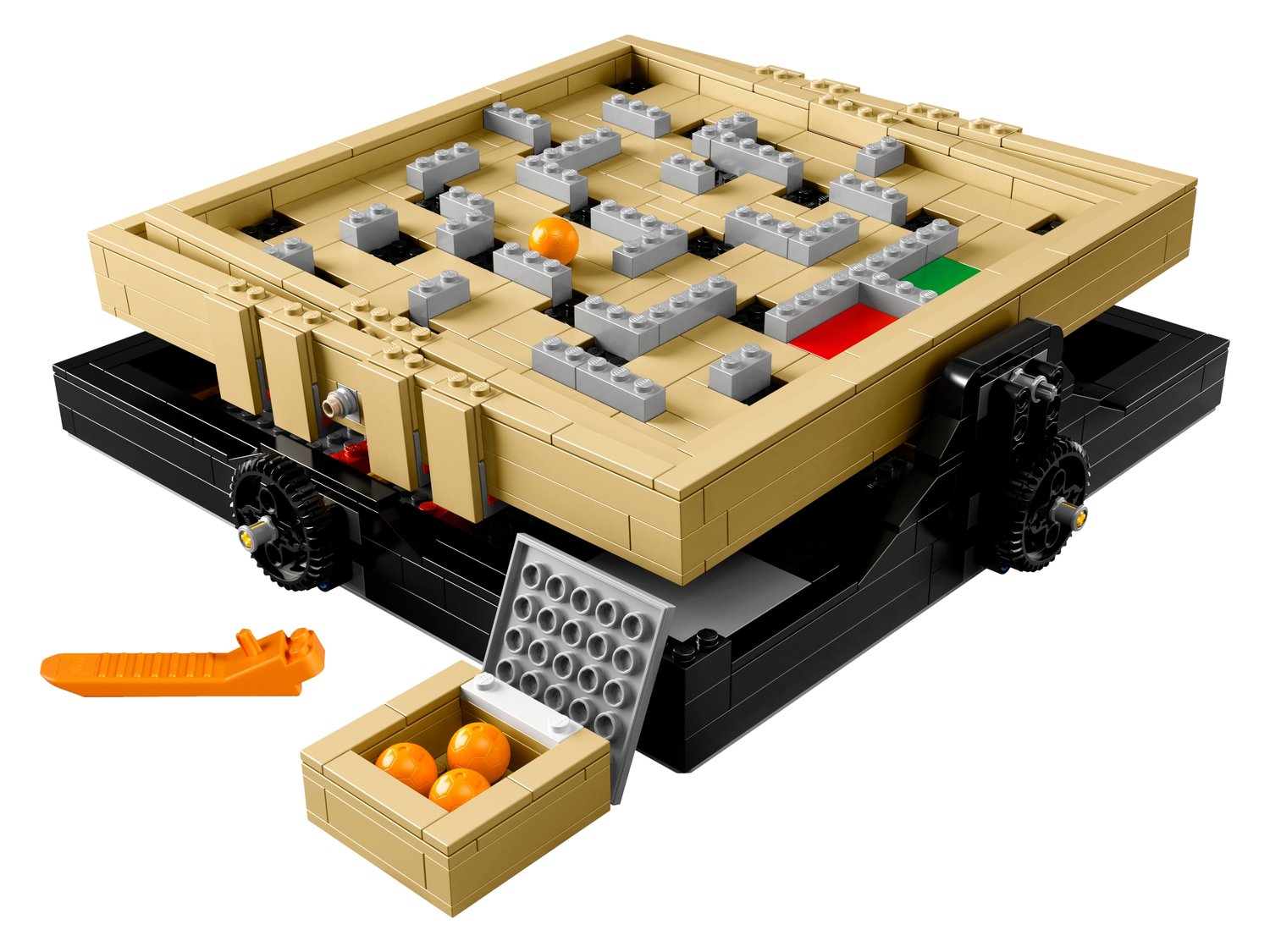
The official 769-piece set uses wheels to tilt the playing surface. It includes four orange balls, a removable storage container and a travel lock. Builders can choose a classic maze or a medieval version with small buildings, then customize the routes. LEGO’s product page identifies Allemann as the fan designer.
In the official image, the bright ball stands out from the restrained tan floor and gray barriers. That makes the moving object easy to find. The red and green areas give the otherwise muted board recognizable destinations. Visually, the hierarchy favors understanding the game before admiring its decoration.
Try the conversation, not just the challenge
Our suggestion for owners is to treat a changed route as an invitation to another builder. Let one person rearrange a section, then ask someone else to attempt it without an explanation. Watch where the intended path becomes unclear before making the next revision.
This is a proposed activity, not a claim about our own testing. It draws attention to the person using the model: difficulty is more interesting when it feels deliberate. Allemann’s bookshelf-to-maze story is a reminder that a shared construction technique can begin a conversation whose final shape neither builder originally expected.
Reporting checked October 18, 2026. Plans and programs can change; follow the linked organizations for current information.