
LEGO’s Harley-Davidson Fat Boy lets a wheel explain the engine
Fat Boy 10269 combines a recognizable motorcycle outline with a mechanical demonstration worth keeping within reach.
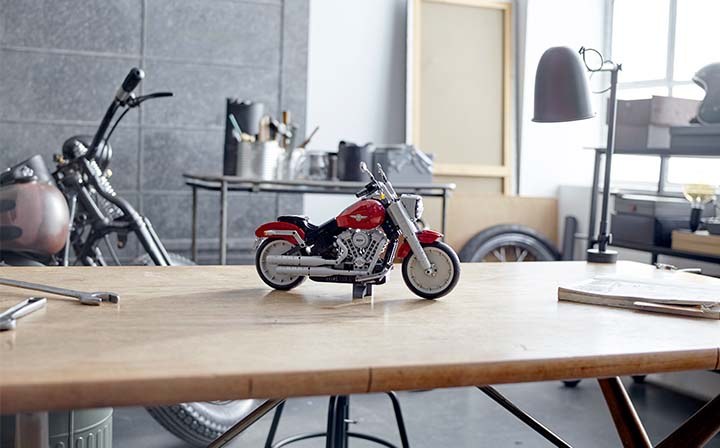
A display that invites a small demonstration
LEGO’s Harley-Davidson Fat Boy 10269 has a useful answer to the question of what a finished vehicle model should do next. Turn the rear tire and the engine’s pistons move. That simple connection gives a viewer something to follow, from the outside of the motorcycle toward its mechanical center.
This retrospective desk review uses LEGO’s official announcement and product specifications. We have not assembled or tested this example, so the discussion concerns its documented design rather than the smoothness of an individual build.
The shape carries the identity
Announced in July 2019, the 1,023-piece motorcycle was developed with Harley-Davidson. LEGO linked its dark red and black finish to the real 2019 Fat Boy’s Wicked Red paint scheme. Its tank, broad tires and solid-disc wheels help establish the silhouette before a viewer notices the smaller fittings.
In our assessment, that order matters. A model can contain many accurate details and still fail to communicate its subject at a glance. Here, the heavy visual presence of the wheels and the curved tank gives the finer machinery something clear to belong to. The contrast between those larger surfaces and the exposed engine makes a closer look feel worthwhile.
Keep the moving details within reach
The official specifications list steering handlebars, adjustable mirrors, movable gearshift and brake controls, a folding kickstand and a separate display stand. LEGO gives the model’s length as approximately 33 centimetres.
Our display suggestion is to think about access as well as shelf space. A motorcycle tucked behind other models may retain its outline while losing the opportunity to demonstrate its movement. Leave enough room to approach it carefully and follow the official instructions when handling it; the small controls should not be treated as lifting points.
For someone showing a collection to a visitor, one deliberate action can be more memorable than a long inventory of details. The wheel-to-piston connection supplies that action without needing a screen or a separate narrative.
A much larger cousin at the launch
LEGO also marked the original launch with a life-size motorcycle build. Its announcement recorded 69,569 pieces and 865 building hours. That was a separate promotional creation, not what buyers received in the retail box.
The two scales suggest different ways of enjoying the same subject: the oversized version supplied spectacle, while the shelf model leaves its owner a manageable mechanism to investigate.
The US product page lists 10269 as retired as checked October 25, 2026. For a secondhand example, we would request clear photographs of both sides, its stand and its controls, then compare them with the official instructions. This is a design retrospective, not a valuation or a prediction of resale returns. The enduring interest is the relationship between a familiar outline and a small piece of visible engineering.
Reporting checked October 25, 2026. Plans and programs can change; follow the linked organizations for current information.