
Guillaume Roussel’s LEGO Globe began with a decision about what to leave out
A creator retrospective on the choices of scale, structure and recognizable geography behind LEGO Ideas 21332.
A world small enough to recognize
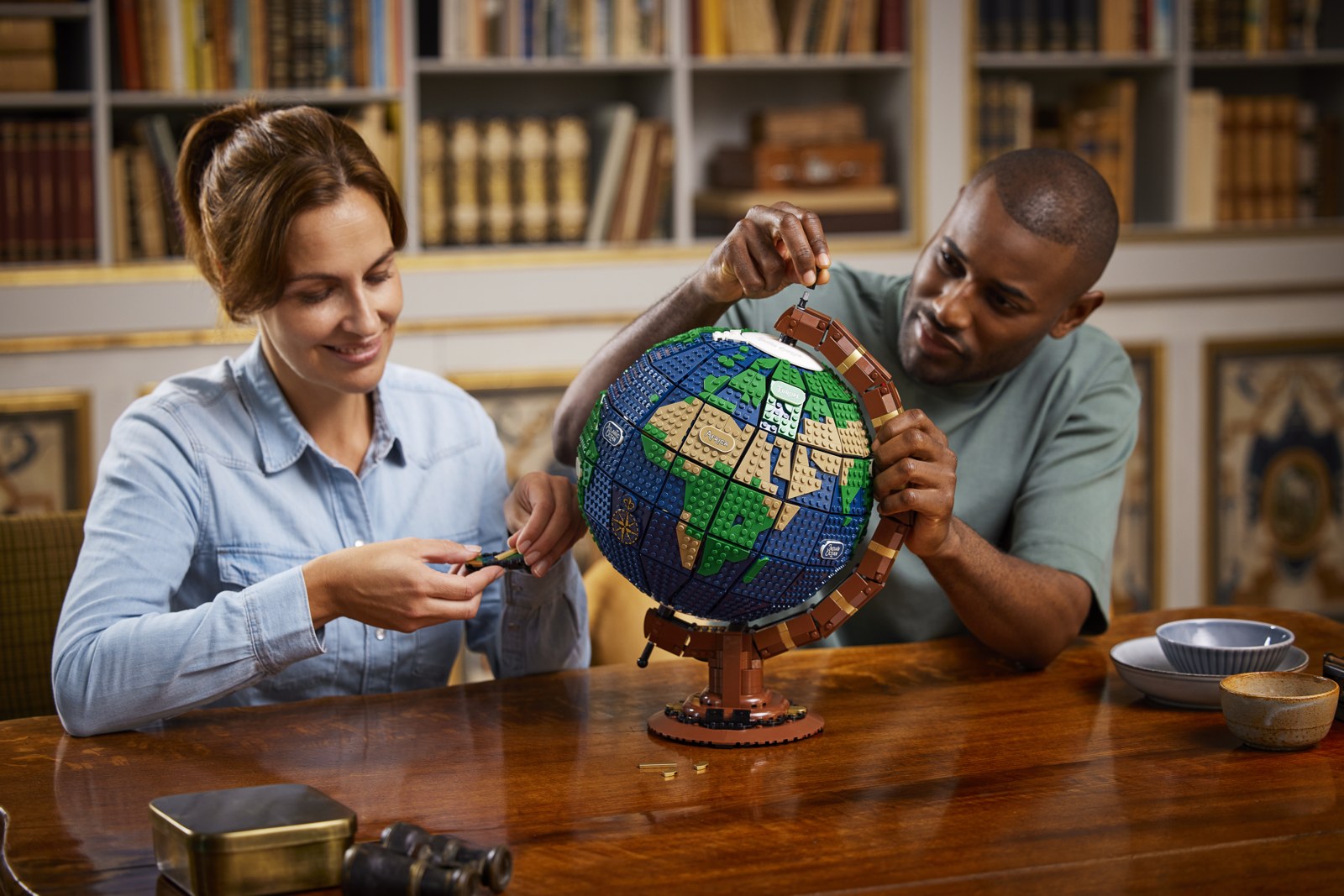
French fan designer Guillaume Roussel did not try to fit every geographic detail into his original Earth Globe proposal. In his July 2020 LEGO Ideas interview, the builder known as Disneybrick55 described choosing a medium scale, between highly detailed large models and much smaller interpretations. His goal was a recognizable world with a vintage appearance.
That makes the project an interesting study in selection. A globe has a clear shape, but the viewer also expects the arrangement of land and sea to make sense. Each coastline therefore has two jobs: to suggest a real place and to work within the available space.
The difficult decisions were in the islands
Roussel said he used a grid over Google Earth as a positional reference. Asia and Oceania were particularly demanding because of their many islands; he simplified the smaller ones. Beneath the surface, his proposal used a Technic structure covered with plates.
These are useful details because they explain the limits as well as the ambition. The project translated geography into a material with fixed increments. A coastline cannot always move by an arbitrarily tiny amount. Our interpretation is that the design’s success depends on maintaining recognizable relationships while accepting visible simplification, rather than promising the precision of an atlas.
The retail globe adds movement and labels
LEGO released The Globe 21332 on February 1, 2022. The launch announcement connects Roussel’s idea with his interest in Jules Verne’s stories. It is a historical release, and this article is a source-based retrospective rather than a hands-on review.
The finished model has 2,585 pieces. Its documented design combines a Technic spinning axis with a System-brick sphere, and uses glow-in-the-dark labels for continents and oceans. Ship and compass decorations reinforce the display’s old-globe character.
A display that benefits from being turned
The official specification gives the completed display a height above 40 centimeters, with a footprint around 30 by 26 centimeters. Rotation matters here: the face presented to a room is a choice, and another part of the world is available with a turn.
For a collector, that makes access to the globe useful when choosing its position. For a fan designer, the more lasting point is Roussel’s willingness to define the model’s limits. Choosing a workable scale created a framework for the rest of the project, from the continents to the supporting structure.
Reporting checked October 14, 2026. Plans and programs can change; follow the linked organizations for current information.