
Grant Davis and Jason Allemann’s LEGO Pop-Up Book made room for shared stories
Revisiting Pop-Up Book 21315, its two fan creators and the 2018 gathering that brought their collaborative idea into the LEGO community.
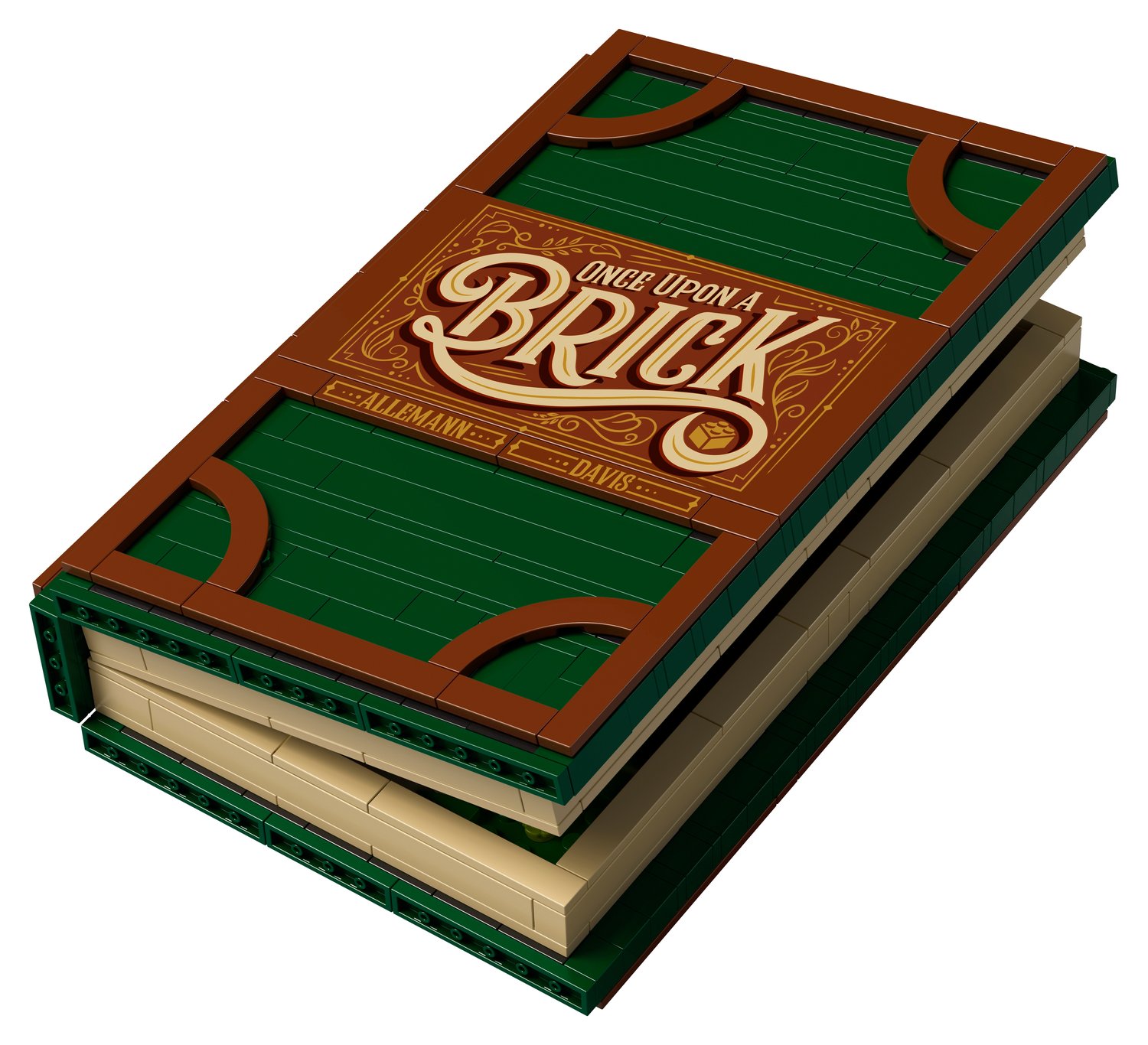
Two names on the cover
The cover of LEGO Ideas Pop-Up Book 21315 carries the surnames Allemann and Davis. They belong to fan designers Jason Allemann and Grant Davis, whose joint submission became an official set in 2018. It is a small but visible acknowledgment that this book has makers as well as characters.
LEGO’s announcement identifies an August 2016 submission, with Wesley Talbott adapting the official model and Crystal Marie Fontan creating its printed elements and minifigures. This retrospective considers that collaboration and the community around the release; it is not a hands-on building review.
One book, two kinds of scale
The 859-piece set provides scenes for Little Red Riding Hood and Jack and the Beanstalk. Four minifigures portray Little Red Riding Hood, Grandmother, the Wolf and the Giant, while Jack is a microfigure. The book opens and closes without dismantling the model, and the central scenes can be exchanged.
Our interpretation is that the contrasting figure sizes do useful storytelling work. A very small Jack can make an ordinary minifigure read as a giant without requiring an enormous character model. It is a neat example of choosing relative scale to serve the story rather than forcing every person into the same format.
A launch became a gathering of builders
The release also produced a real community moment. LEGO Ideas’ account of the October 27, 2018 signing at Washington Square in Oregon describes Davis and Allemann meeting fans, signing sets and displaying their original models and alternate stories. Ship in a Bottle creator Jake Sadovich attended, along with members of PortLUG.
That historical event matters because it shows what a fan-designed set can bring together beyond the object in the box. A recognizable finished product gives strangers a starting point for talking about techniques, earlier versions and their own building interests. The shared story includes how the model came to exist.
Let the reveal be part of the story
For owners revisiting the book, our suggestion is to think about the transition between closed and open as part of the presentation. Choose the viewing position before beginning, and give the scene time to reveal itself before explaining every detail.
A small display can be memorable when it controls when its audience discovers something. Here, the cover promises a story while the opening supplies a change in shape. That combination is the enduring appeal of Davis and Allemann’s idea: a familiar object becomes a miniature stage that can be shared, closed and opened again.
Reporting checked October 18, 2026. Plans and programs can change; follow the linked organizations for current information.