
LEGO’s Ferrari helmets put the driver ahead of the car
Leclerc’s red helmet and Hamilton’s yellow version use personal markings and minifigures to give Ferrari fans a different kind of display.
Two identities within one team
A Formula 1 car gives a LEGO designer a long silhouette to work with. The Ferrari helmet sets released in 2026 concentrate the subject into something much smaller: a rounded shell carrying a driver’s colors, number and personal associations. Charles Leclerc’s 43014 and Lewis Hamilton’s 43022 share the Ferrari connection while remaining immediately distinguishable on a shelf.
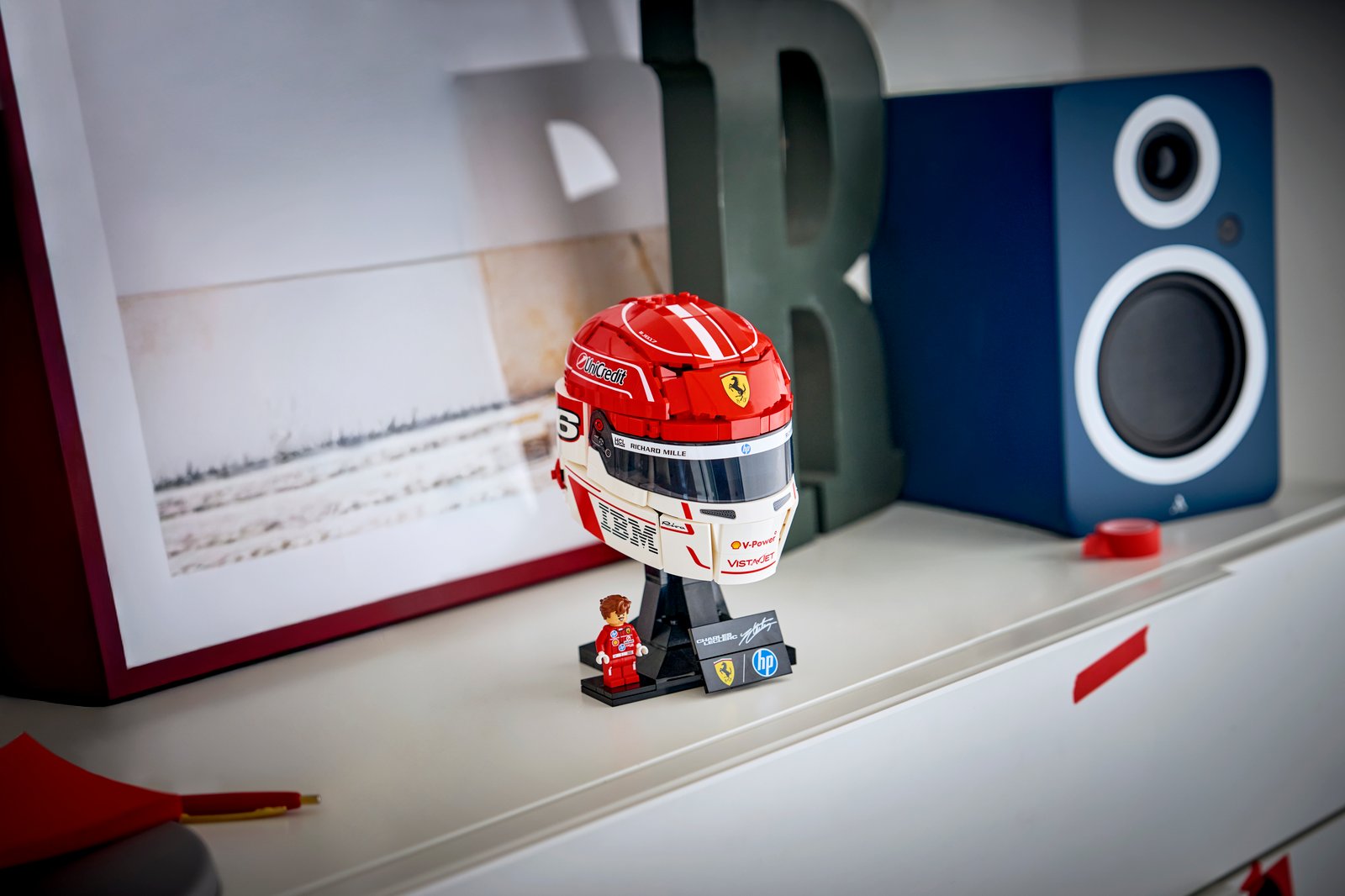
LEGO’s March 5 announcement tied the models to the drivers’ 2025 helmet designs and set a May 1 release. Leclerc’s version contains 886 pieces and Hamilton’s 884. Both include a signature plaque and a driver minifigure, making the finished display explicitly about the person as well as the equipment.
Details that identify a person
The Leclerc product page describes the model’s Rosso Monaco red finish, number 16 and personal decoration referring to his father and Jules Bianchi. The official photograph shows the minifigure positioned beneath the helmet, beside the printed signature. That arrangement repeats the identity at two scales: one in the recognizable helmet graphics, the other in the little figure wearing the team’s racing suit.
Our interpretation is that the minifigure keeps the helmet from reading as an anonymous piece of sporting equipment. It creates a human reference point without trying to make the large shell wearable. At over 18 cm tall, the completed retail model is designed as a display object.
A different color, the same display idea
Hamilton’s product listing identifies Modena yellow, printed decorations and his red Scuderia Ferrari HP racing suit on the accompanying minifigure. Its color therefore creates a strong contrast with Leclerc’s red helmet even though both belong to the same team. The driver’s number and signature supply more specific identification than the Ferrari badge alone.
The launch also involved a separate pair of life-size promotional helmets built by Ryan McNaught and his team. LEGO records that each took 60 hours to build. Those larger models, carried by the drivers in Melbourne, should not be confused with the retail sets shown in product listings.
For a collector, the appeal here is a change of subject within motorsport. A car model directs attention to bodywork and mechanical form; these helmets direct it to the markings that distinguish one competitor from another. This is a source-based desk assessment, not a hands-on review of the construction or a report from the paddock.
Reporting checked November 2, 2026. Plans and programs can change; follow the linked organizations for current information.