
The hidden joints that let LEGO’s dried flowers spread across a table
Chris McVeigh’s autumnal centerpiece looks organic because its structure solves a very practical problem: how to assemble flowers pointing in different directions.
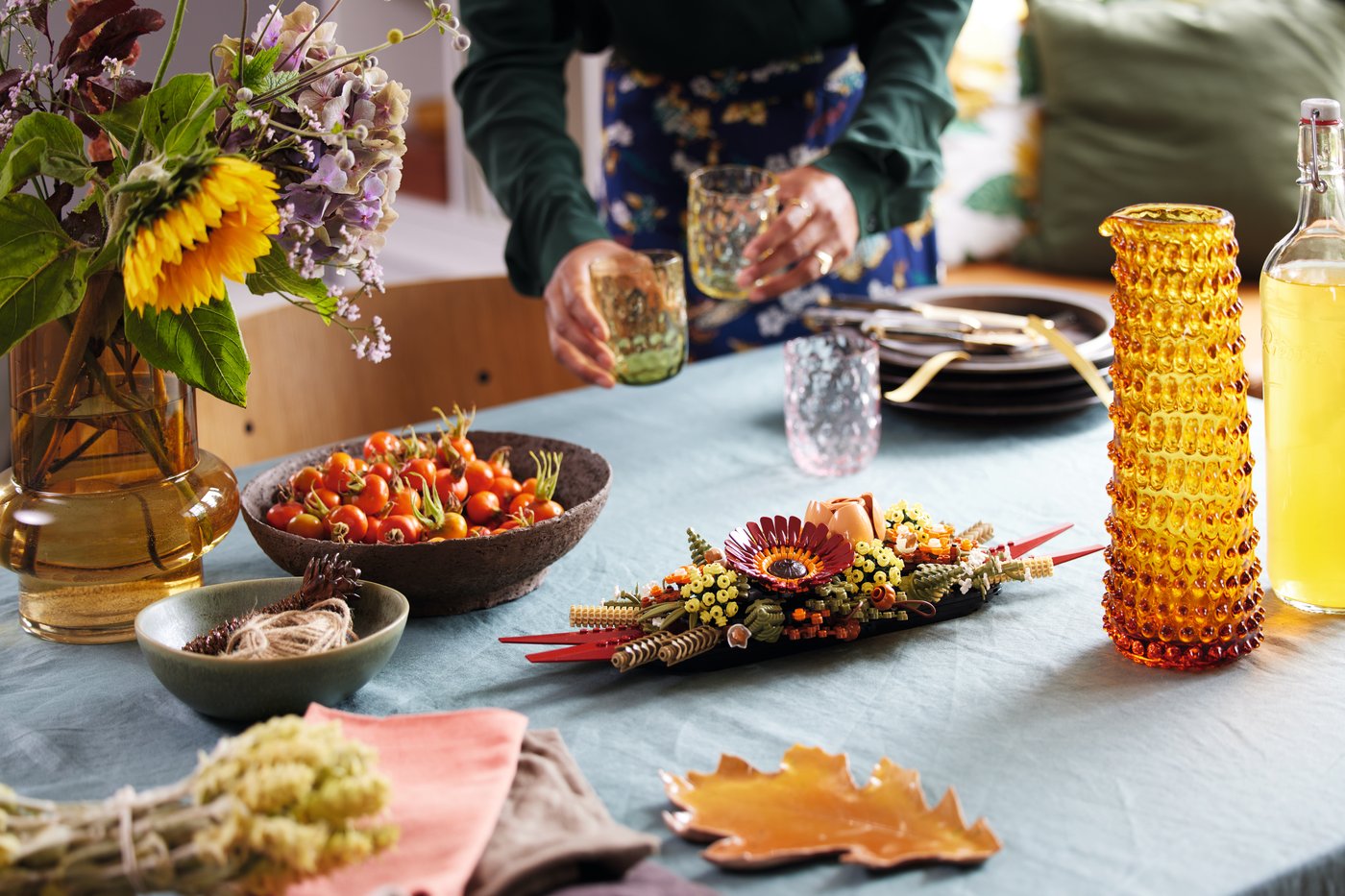
A low arrangement with a complicated interior
The flowers in set 10314 spread outward instead of rising from a vase. That gives the Dried Flower Centerpiece an unusually low profile: LEGO lists a finished height of about 7 centimetres, against a width of 40 centimetres. A gerbera and rose anchor the arrangement, with smaller plants filling the spaces around them. The 812-piece model can sit on a table or hang on a wall.
Those proportions matter in this retrospective desk analysis. The display takes up a broad patch of surface while leaving the space above it open. Its floral identity depends on directions, overlaps and uneven edges, rather than the neat vertical outline of a pot. A brick-built centerpiece therefore has to organize considerable structural order beneath an apparently informal surface.
Making the construction legible
In LEGO’s published designer interview, Chris McVeigh explains that many components use ball joints. His work included concealing those connections and finding a sensible way to group the plants. He reports physically building upwards of 40 copies during development, with much of that work concerning the mounting structure.
The revealing detail is his decision to divide the build into two parts to make it understandable. That division then opened another possibility: joining copies into larger arrangements. An L-shaped bracket allowed four- and six-spoke configurations while maintaining rigidity. McVeigh also cautioned that extending the chain still further would affect rigidity.
This makes the modular feature more interesting than an optional enlargement. It emerged from the same problem the instructions needed to solve. The joints had to serve both a natural-looking composition and a sequence a person could follow, while keeping the supporting framework out of sight.
Two builders, one finished object
The January 5, 2023 announcement presented the split design as a way for two people to build simultaneously. It also showed the difference between one centerpiece and arrangements assembled from additional sets. That distinction remains useful when looking at promotional photographs: a larger circular display does not represent the contents of a single box.
The interesting outcome is a model whose collaboration has a physical structure. Each builder can produce a substantial portion, and the meeting point becomes part of the finished arrangement. The flowers hide the engineering, but the division of the build reveals another side of it: construction can be designed around the people at the table as carefully as around the object that will remain there.
Reporting checked November 5, 2026. Plans and programs can change; follow the linked organizations for current information.