
Discovery 10283 tells a bigger story when Hubble comes out of the cargo bay
Revisit the 2021 LEGO shuttle through the mission it depicts: carrying the Hubble Space Telescope into orbit in April 1990.
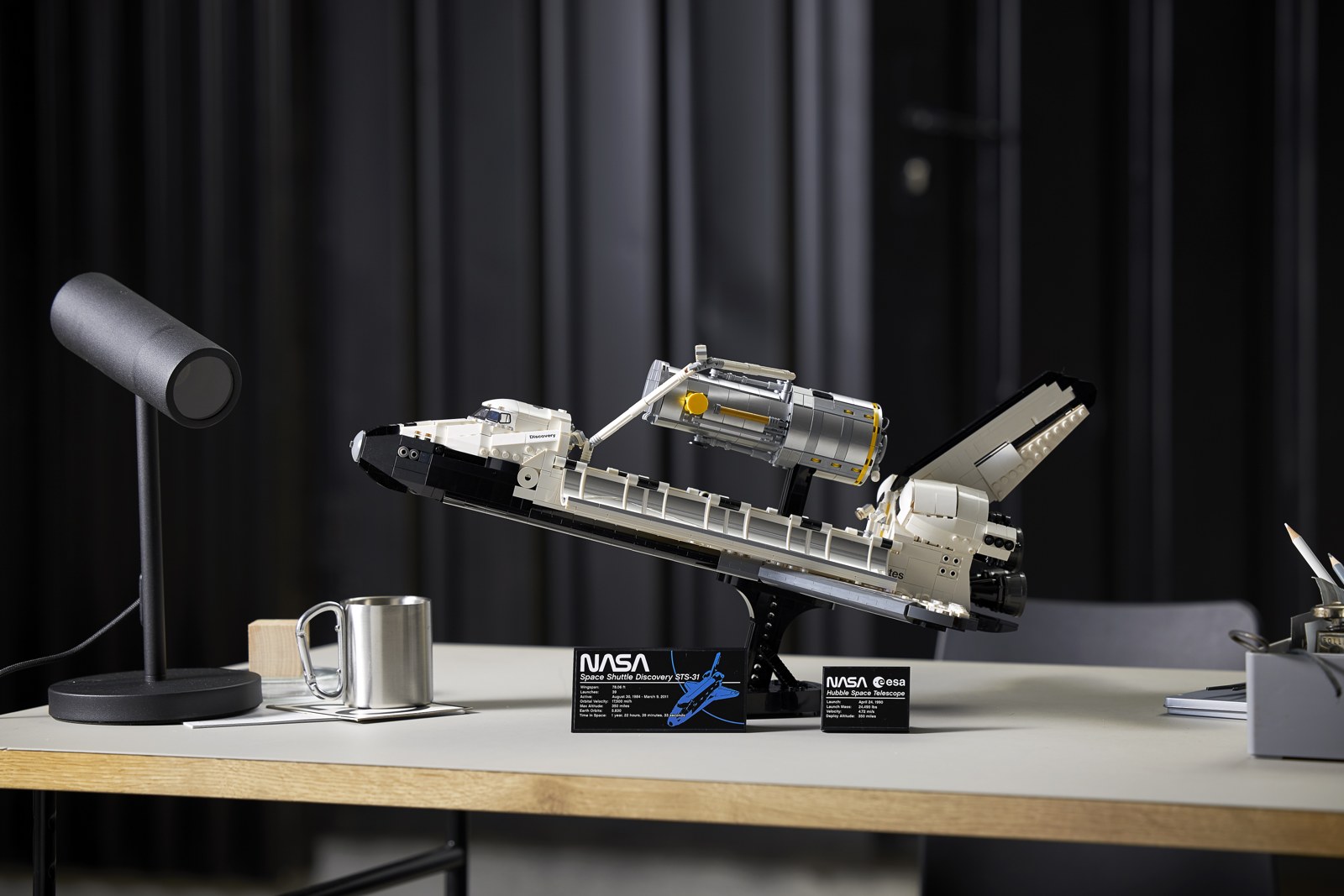
A shuttle model with a particular mission
LEGO announced NASA Space Shuttle Discovery 10283 in March 2021, pairing the orbiter with a model of the Hubble Space Telescope. The company developed the set with NASA and involved former astronaut Kathy Sullivan in its launch presentation. Sullivan had flown on the actual STS-31 mission.
Revisiting the set in 2026 offers a chance to look beyond the familiar shuttle outline. The telescope gives this model a specific destination in space history. This is a source-based retrospective, not a report of a recent release or a hands-on assessment of its construction.
What happened in April 1990
NASA records Discovery’s STS-31 launch on April 24, 1990, and its return to Edwards Air Force Base on April 29. The five-person crew consisted of commander Loren Shriver, pilot Charles Bolden and mission specialists Steven Hawley, Bruce McCandless and Kathryn Sullivan. Deploying Hubble was the mission’s central task.
A useful companion to the LEGO model is NASA’s mission page, which includes a photograph of the telescope being prepared for deployment. Comparing a model with the historical record makes the subject more concrete: the cargo was a scientific observatory, and its journey depended on the work of a real crew.
Three moments to examine in bricks
LEGO’s product documentation describes an opening payload bay, a robotic arm and a Hubble model with movable solar panels and an aperture door. Separate stands allow the shuttle and telescope to be shown together or individually. The cockpit also opens to reveal the flight and mid-decks.
Our suggested way to explore the model is to consider three stages: carrying the telescope, moving it clear of the bay, and seeing it as a separate spacecraft. Use the official instructions for supported arrangements. The sequence encourages questions about where an object fits and how it gets into position, rather than simply listing moving features.
Let the mission lead the next conversation
For a family discussion or club presentation, a short caption can do more than a long list of specifications. Name Discovery, STS-31 and Hubble, add the April 1990 dates, and invite visitors to look at NASA’s photographs. Keep the model’s simplified mechanisms distinct from the engineering of the real spacecraft.
Then ask one focused question: what changes when the telescope leaves the vehicle that carried it? That opens a conversation about transport, deployment and purpose. The reward of returning to an older LEGO space set is that the research can keep growing even when the bricks themselves have stayed exactly where they were.
Reporting checked October 2, 2026. Plans and programs can change; follow the linked organizations for current information.