
Alexis Dos Santos gave Tintin’s Moon Rocket a view from inside
Hergé drew a spacecraft recognizable from across a launch site. A fan-designed LEGO model also makes room for what the travelers see.
A rocket seen from the ground
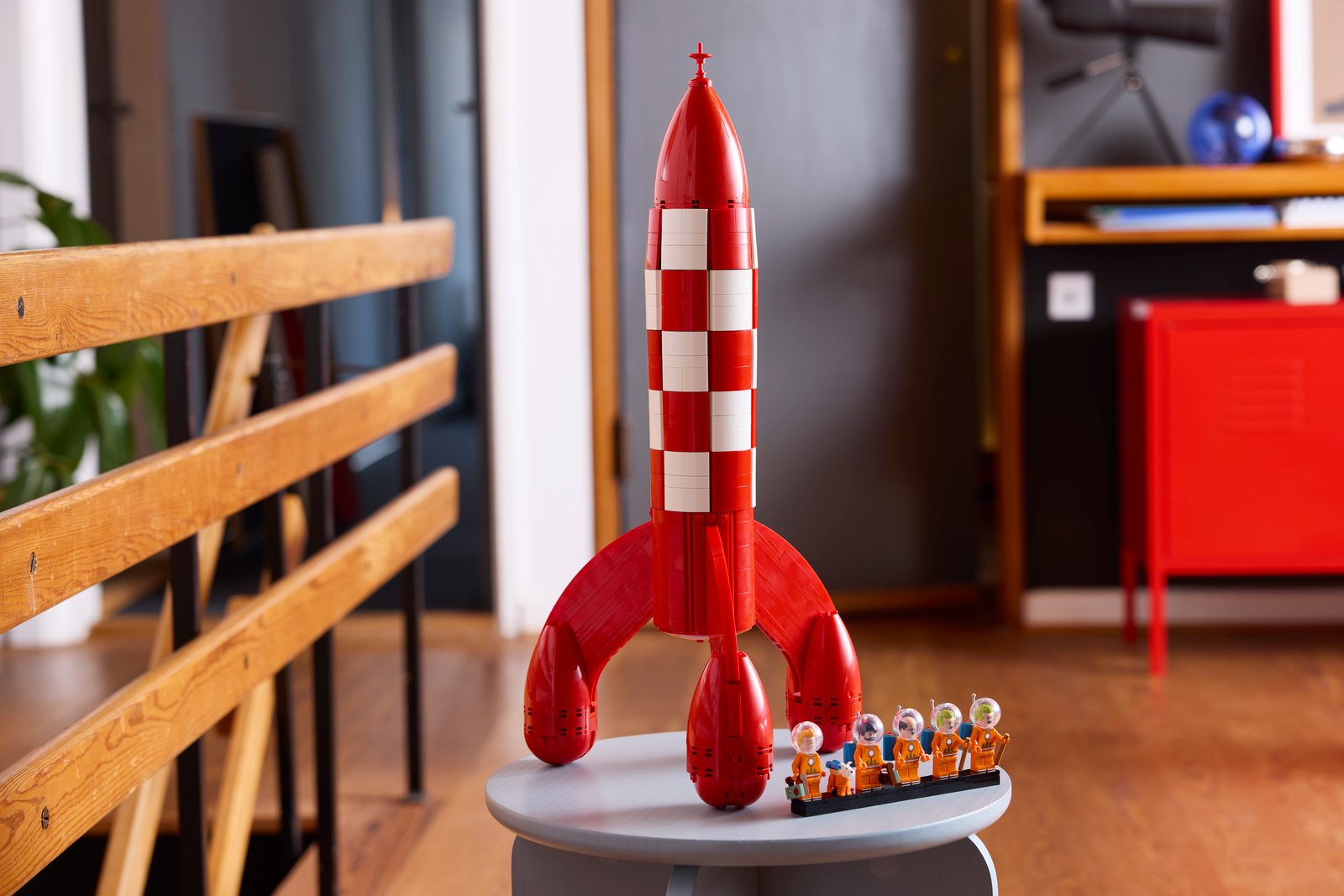
The red and white checks on Tintin’s rocket do something a plain coat of paint could never do. On a round body, the edges of the squares make a turn visible. A reader can follow the pattern around the hull even when Hergé gives the ship only a single panel. That leaves a brick builder with an exacting assignment. The squares must stay legible as the hull narrows to a point.
The official Tintin archive describes Destination Moon, published as an album in 1953, as the story of preparing and launching Professor Calculus’s expedition from Syldavia. It also records a subtle change across editions. Early prints gave the checks a more orange hue than later ones. What persists across those versions is the pattern itself, recognizable even when the ink changes.
Building around a curve
Alexis Dos Santos, a Portugal-based builder who submitted the rocket as TKel86 on LEGO Ideas, identified two challenges in the design: shaping the curve and joining the three floors. The first is visible to anyone who passes the model. The second belongs to the builder who has to make one level meet the next inside that changing outline.
His proposal drew 10,000 supporters and passed LEGO’s review. The company introduced set 21367 in March 2026. The official photograph gives a sense of its proportions. Three broad red fins sweep out to rounded feet. Between them the body seems to hang in the air, with enough space underneath for the crew figures to stand alongside it.
A look back at Earth
For all the attention the hull attracts, the most specific reference to the travelers is hidden up near the nose. A panel lifts away to give access to a control room. Put a figure there and the model can recall a moment from Explorers on the Moon when the crew looks back toward Earth.
It is an economical change of viewpoint. From across the room we see a spacecraft the way an observer on the ground might. With the panel off, a single figure high above the fins gives us somewhere else to imagine standing. One view belongs to the people who watched the rocket go up. The other belongs to the people who went with it.
Reporting checked November 3, 2026. Plans and programs can change; follow the linked organizations for current information.