
Alex Sahli’s LEGO Italian Riviera kept growing after the journey
The fan designer began with reference pictures, then returned from Italy with reasons to expand his coastal village.
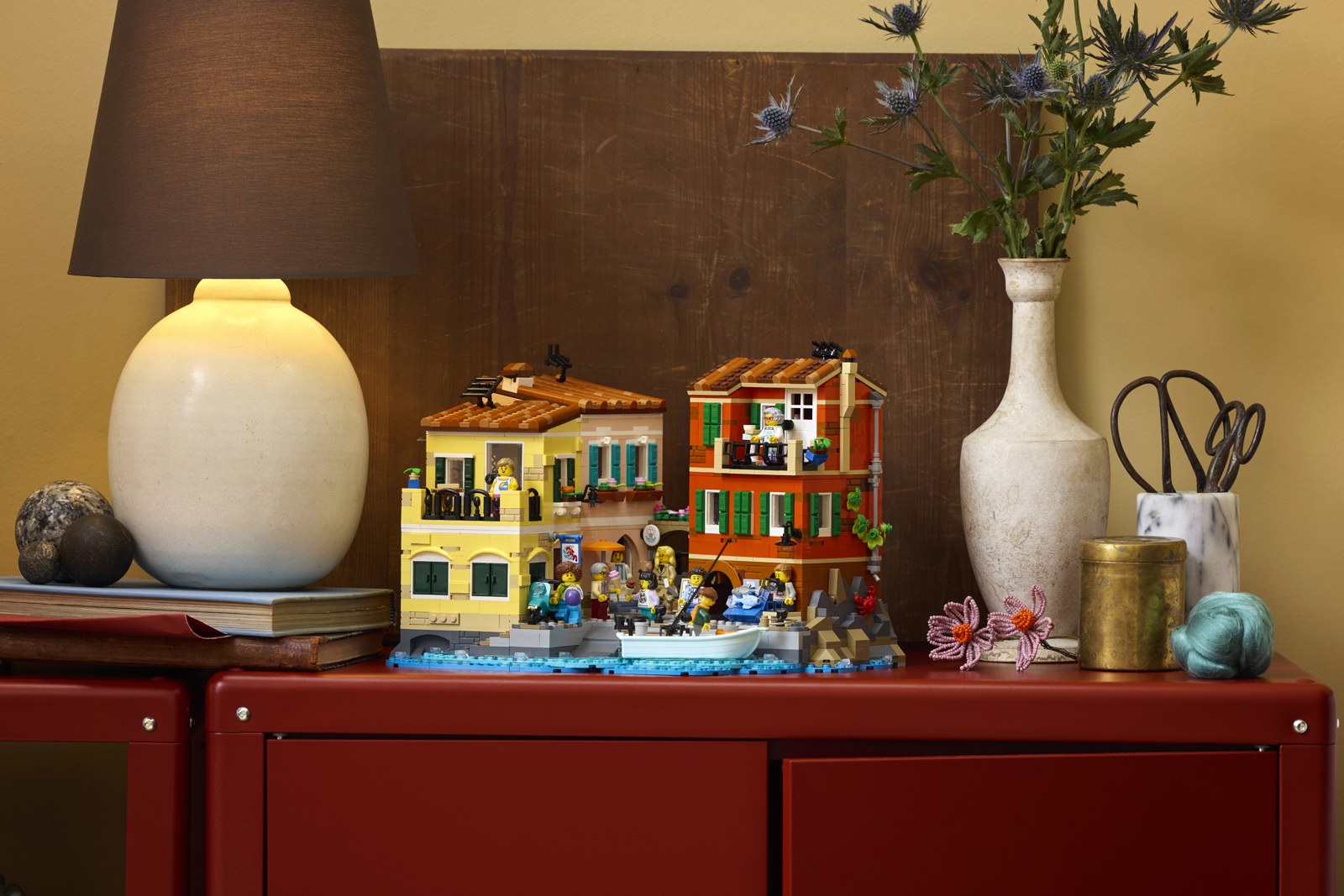
A model before the visit
Alex Sahli’s Italian Riviera did not begin as a model built after a holiday. In his July 2024 LEGO Ideas interview, he explained that the first design came a few weeks before his trip to Italy. Reference photographs helped him study the towns, and he tried different color schemes before settling on the composition.
The villages of Cinque Terre were the main inspiration, with another influence from the Amalfi Coast. The trip then gave him reasons to return to the project. Later expansions added landscape and buildings, followed by a train, tunnel and castle tower. He wanted the model to reflect the place more closely.
Two different destinations for one idea
Sahli distinguished the roughly 3,000-piece Ideas submission from a much larger personal version of about 7,700 pieces. Those later additions did not become updates to the submission because they exceeded the platform’s piece limit.
That distinction matters when looking at photographs of his work. A fan’s continuing personal build and the concept being considered for a retail set can develop along different paths. One can keep spreading across a table while the other needs a defined boundary.
A coast with people in it
LEGO announced the resulting 3,251-piece Italian Riviera, set 21359, in July 2025. Its three buildings include a gelato shop, diving equipment shop and fish market, with homes above. Removable roofs and upper stories make the interiors accessible. Ten minifigures supply residents and visitors, including a grandmother teaching her grandson to make trofie pasta.
In that announcement, Sahli identified arranging buildings at different angles while preserving stability as a structural challenge. He also highlighted texture across the water, stonework and houses. These are details from the project’s release history, not a new launch or a claim of current stock.
The return trip is part of the design
Our reading of Sahli’s account is that travel became a conversation with an existing model. The first version gave him something concrete to compare with what he saw; the later versions gave those observations somewhere to go. That is more interesting than treating a finished scene as a single postcard.
For anyone following the creator behind the commercial set, the larger personal village is also a reminder that publication need not end a project. The product has its own finished form, while the builder can continue investigating the same coast, railway or hillside at a different scale.
Reporting checked October 27, 2026. Plans and programs can change; follow the linked organizations for current information.